Perry Artese, February 1 ,2020
Part II the Teacher
“Howard Pyle’s unparalleled career and his exceptional talents in teaching generations of artists to grow their successful careers in illustration has left an indelible mark on American Culture.” (Cutler,2017).
It’s iconic-The Brandywine School. Those artists and the generations of artists that are still practicing were, and are still rich contributors to print, magazines, catalogs, fine arts, etchings, and mural arts. Pyle deserves all the credit. Illustration and teaching were his passion at the turn of the century; and quite lucrative for him too.
“1900 Howard Pyle earned almost $4,000 per year teaching only two classes per week at Drexel Institute, which is about $100,000 dollars today. In addition, he published approximately 100 illustrations, which translates to and additional $2,500,000-$3,000,000 annual income, as well as his income from his prolific work as a writer.” (Cutler, 2017, p. 4)
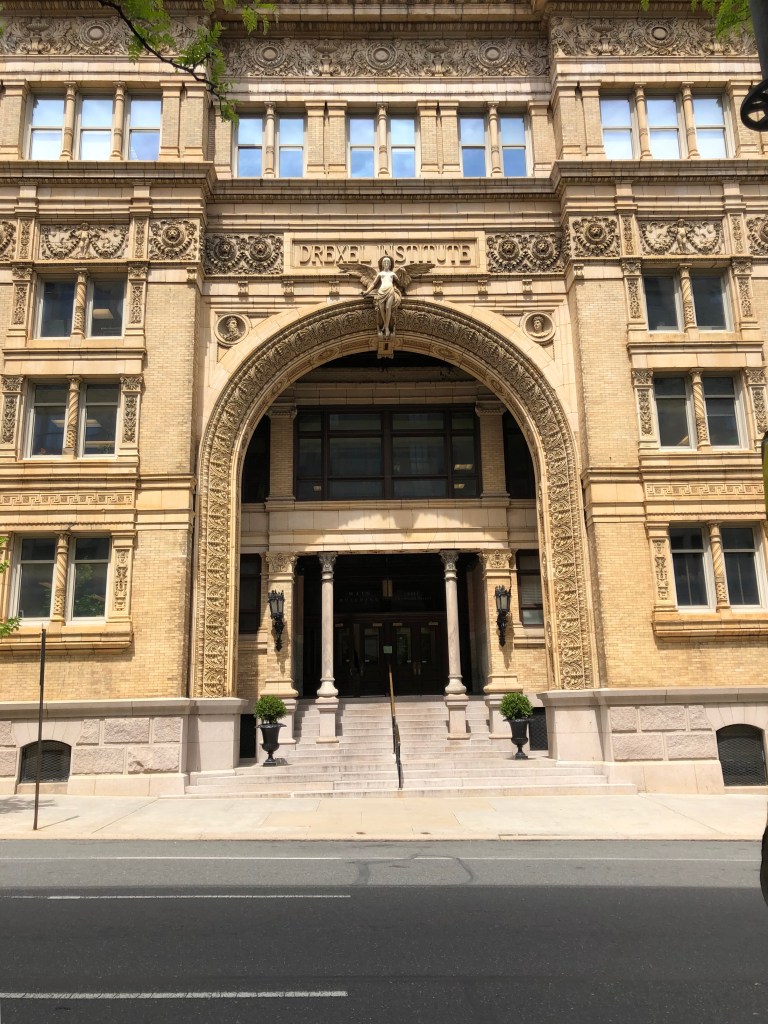
The Drexel Institute of Art, Science and Industry, was founded in 1891 by (Anthony J. Drexel). Pyle’s passion was kindled in New York while he was a member of the Arts League and Salmagundi Club. He returned home to Wilmington to fulfil that passion. Starting at home on Broom Street, he began to teach, eventually he was a teacher at Drexel around 1894. Pyle taught there for six years. The list of students he taught is lengthy and many of them were women, which Howard’s egalitarian ethics, as literature suggests, promoted. There were the Red Rose Girls, the trio of women, who with Pyle, became the envy of their contemporaries, and the catch of major publishers of the day. Violet Oakley, Jessie Wilcox Smith and Elizabeth Shippen were the new vanguard of talent. Oakley, at the urging of Pyle, went into mural painting and in 1902 filled the Governor’s Reception room at our state capitol with fine art murals. The series is called The Creation and Preservation of the Union. The Red Rose Girls, who met at Drexel, first lived and worked together in Villanova at the Red Rose Inn, then settling at Cogslea in Mount Airy, Philadelphia. This was about 1910. They were published in Collier’s Weekly, Harper’s Bazaar, Scribner’s and Good Housekeeping magazines; instant celebrities for their illustration, stories and art. Timing, and Pyle’s connections to publishers made each illustrator of his school happily employed-women artists were empowered. It was also quite convenient that one of the major publishers of the day Curtis, was in Philadelphia on 6th street. Moving images of Colonial times by Violet Oakley filled books and periodicals of the day, my favorite being Woman Curtsying Before Rising Colonial Man, from White Aprons, by Maud Wilder Goodwin. (Cutler, 2017).
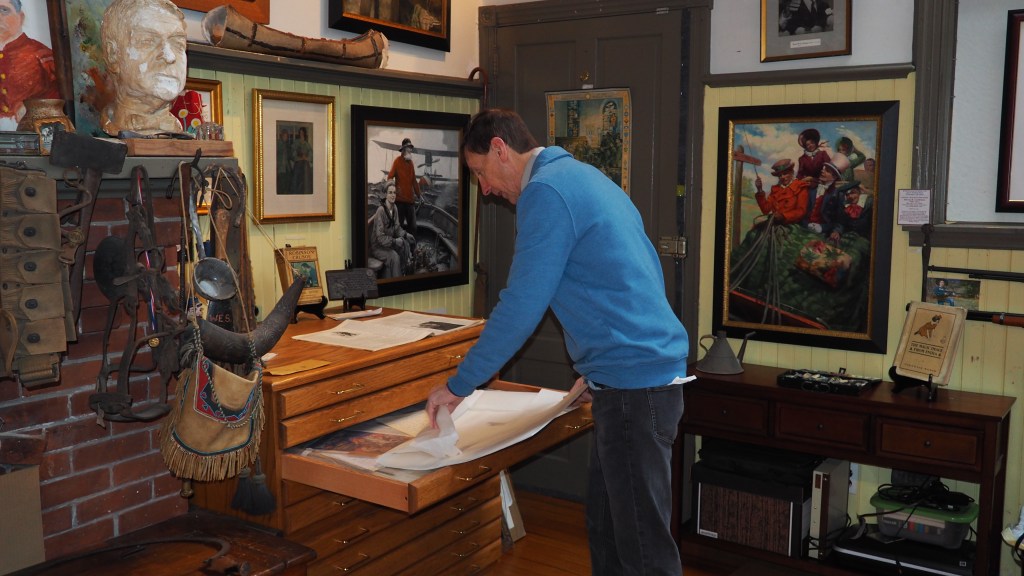
There are two other painters I want to mention in this article, Frank E. Schoonover (1877-1972) and Maxfield Parish (1870-1966), both took on and expanded on Pyle’s philosophy. Schoonover, who once traveled on a 1,200-mile trip through Canada and Alaska, sometimes by dog sled, was immersed in the imagery of the wild and untamed. Frank was also one of the lucky students of Howard’s to study with him in Chadds Ford, PA. Again, it was Pyle who help this illustrator get commissioned work. Schoonover’s studios are located on Rodney Street in Wilmington and are still in use today. John R. Schoonover, Frank’s grandson maintains the historic property and does art restoration, consulting and is the source for everything about the Pyle Illustrators. I sat down with John and we discussed what illustration arts is about and how it is on a comeback. “Pyle though was underestimated in the art market”, John stated. “He just missed his time, he was a man behind the scenes, today, illustration art is all about N.C. Wyeth and Norman Rockwell.” I recommend that you take a short ride to the Rodney Street studios in Wilmington and see some fantastic Schoonover art and ephemera. John’s always happy to show visitors and scholars around.
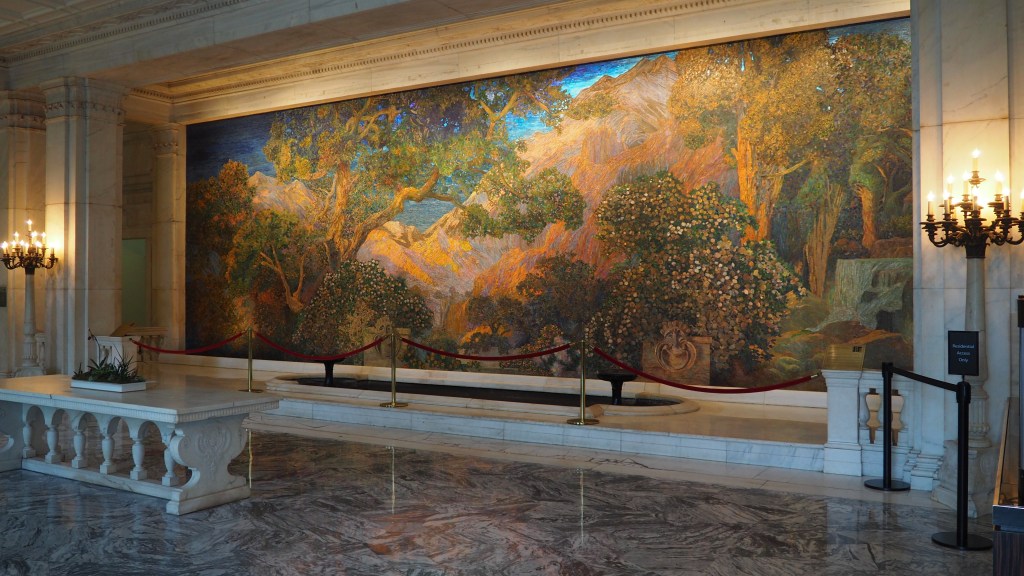
As I dug more into the work of the students at Drexel, I came across some magical work of a very young Maxfield Parish (1870-1966). Parish who, while touring Europe with family corresponded to his cousin Henry Bancroft with whimsical illustrated letters. I encourage you to view them at the Delaware Art Museum’s Digital Archives. Maxfield though won the illustration day with literature mentioning that his work was in one quarter of American homes, through prints and calendars.; The Edison Mazda (1918-1934) was one of many. He was quite the entrepreneur, and colorist. His blues, known as “Parrish Blue,” was his trademark. He was not a lone painter and collaborated on a remarkable tile mosaic with Louis Comfort Tiffany called “The Dream Garden.” It is installed in the Curtis Building on 6th and Walnut Street in Philadelphia and has over 100,000 tiles, over a year to complete and install. (Nichols, 2019). My two favorite Parish works are “Daybreak” (1922) and the gorgeous “Aquamarine” 1917.
The Drexel Institute provided some brilliant students scholarship money to attend art class in Chadds Ford and Newel Convers Wyeth was one of the happy students who spent, five summers there[i]. N. C. moved to Chadds Ford and became our famous neighbor, fathering the next generation of realism that is – The Brandywine School. N.C. was a giant and the engine of the Brandywine with larger than life work notable his Treasure Island illustrations. He unfortunately met an early death on a railroad crossing on Ring Road in 1945, the underlying subject of many of Andrew Wyeth’s works.
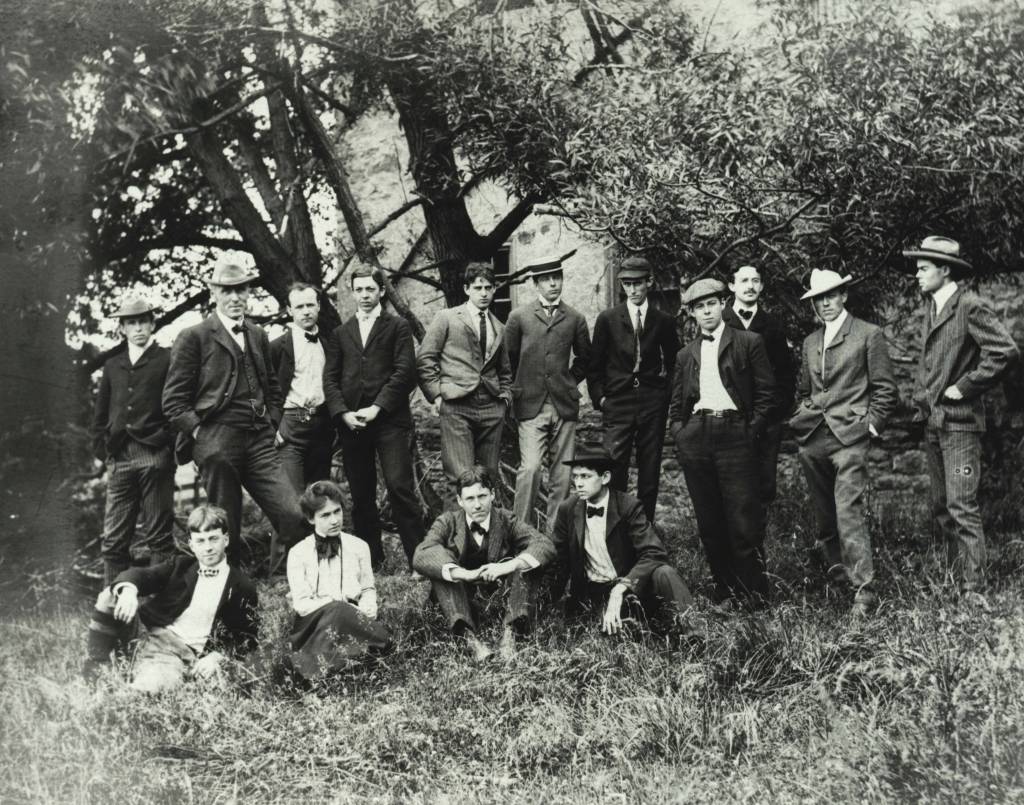
Pyle and his students, 1902-06:Howard Pyle Manuscript Collection, Helen Farr Sloan Library and Archives, Delaware Art Museum
It was an honor to bring to you some information on arts in our historic area. The Brandywine School is rich and ever-changing, evolutionary, historic and very, very active. I’ve left hundreds of contributors out of this work. It started with Quaker thought, to find the “inner light within,” and I argue that “the light” is really its foundation. So, we live and breathe in this historic area, settled by Penn’s Quakers who became remarkable patriots, and artists. Thank you Garnet Valley Living for letting me share this story. I encourage everyone to visit both the Delaware Art Museum and the Brandywine
River Museum to get a close look at the work of our talented neighbors.
Bibliography
Cutler, C. a. (2017). Howard Pyle His Students & the Goldend age of American Illustration. Philadelphia: American Civilization Foundation.
Nichols, A. (2019, December 27). Freeman’s. From https://www.freemansauction.com/news/dream-garden-maxfield-parrish-philadelphia-landmark
The author would like to thank Paula Marantz Cohen, Dean of Pennoni Honors College at Drexel University for her assistance with gathering research materials and John Schoonover of Schoonover Studios for his contribution. http://www.schoonoverstudios.com
Historic Photos used by permission from the Delaware Art Museum
 Philly Music & Arts Notes